
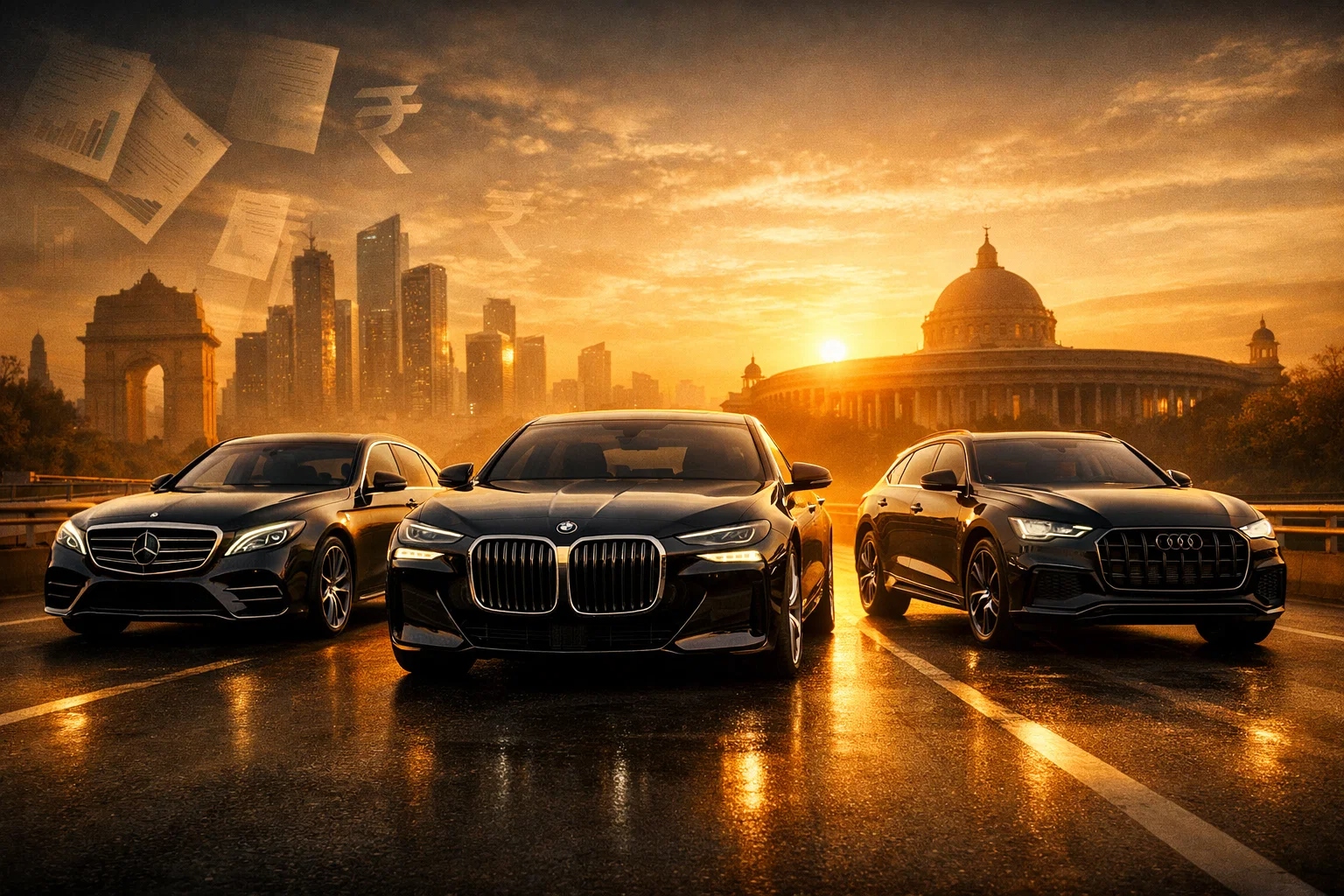
The Union Budget 2026 is no longer just a fiscal document; it is the starting signal for the next era of Indian “premiumization.” As Finance Minister Nirmala Sitharaman prepares to present the budget on February 1st, 2026 (a rare Sunday session), the luxury automobile industry-anchored by titans like Mercedes-Benz, BMW, and Audi-stands at a crossroads.
With the luxury segment currently representing roughly 2% of India’s total car sales, the 2026 Budget has one primary mission: to transform this niche into a mainstream powerhouse.
1. The 2026 Luxury Pulse: High Value, Tight Margins
India’s luxury vehicle market crossed the 50,000-unit milestone in 2024, but 2025 saw a cooling period with only 1.6% growth. Heading into 2026, the sentiment is one of “cautious optimism.”

According to Santosh Iyer, MD & CEO of Mercedes-Benz India, the market is currently battling currency volatility and “entry-level slowdown.” However, the demand for Top-End Vehicles (TEVs)-those priced above ₹1.5 crore-is surging. Mercedes reported an 11% growth in their S-Class and Maybach portfolio, while BMW’s EV portfolio grew by a staggering 200% in the last fiscal cycle.
2. The “Big Ask”: Rationalizing Customs Duties
The most significant barrier for luxury car buyers in India remains the Import & Customs Duty. Currently, fully imported vehicles (CBUs) face:
- 70% duty for cars under $40,000.
- 110% effective duty for cars over $40,000.
The Industry Expectation: Auto leaders are pushing for a single-slab customs duty. If the 2026 Budget rationalizes these rates to a uniform 60% or 70%, we could see a price correction of ₹8 lakh to ₹15 lakh on popular imported models like the Audi Q8 or BMW X7.
3. GST 2.0: The End of “Cess Confusion”?

One of the most transformative updates of late 2025 was GST Reform 2.0. Before this, luxury cars were taxed at a base 28% GST plus a fluctuating “Compensation Cess” of 15% to 22%, leading to total taxes of up to 50%.
| Vehicle Category | Old Tax Rate (GST + Cess) | New GST 2.0 Rate (2026) | Impact on Price |
| Small Cars (<1.2L) | ~29% | 18% | Significant Drop |
| Luxury SUVs/Sedans | 43% – 50% | 40% (Flat) | Moderate Reduction |
| Electric Vehicles | 5% | 5% | Highly Incentivized |
Strategic Insight: While the headline rate for luxury cars increased to 40%, the removal of the cess actually lowered the effective tax burden for many SUVs. Budget 2026 is expected to provide further clarity on “Inverted Tax Structures” for hybrid vehicles.
4. Luxury EVs: The “Make in India” Mandate

The 2026 Budget is expected to double down on the PLI (Production Linked Incentive) Scheme. With battery demand in India projected to hit 256 GWh by 2032, the government is likely to offer:
- Reduced duties on lithium-ion cell components.
- Exemptions for capital goods used in EV manufacturing.
For the buyer, this means that the Mercedes EQS SUV or the BMW i7, currently priced as ultra-premium imports, might see lower price tags if local assembly (CKD) increases.
5. Expert Opinion: Why Infrastructure is the Secret Sales Driver
It’s not just about the taxes. The 2026 Budget’s allocation for Capital Expenditure (Capex) on Highways is a direct driver for luxury sales.
“We would like to see more capex allocated for roads. Improved intercity connectivity isn’t just an economic necessity; it’s the playground for performance luxury cars,” says an industry analyst.
6. FAQ: Luxury Cars & Budget 2026
Q1: Will luxury car prices go down after Budget 2026?
It depends on the import status. If customs duties are rationalized, CBU (Completely Built Unit) prices will drop. However, rising input costs and rupee depreciation might lead to 2% quarterly hikes from brands like Mercedes.
Q2: Is it better to buy a Luxury EV or a Petrol SUV in 2026?
From a tax perspective, EVs are the clear winner with a 5% GST rate compared to 40% for petrol luxury cars.
Q3: What is the “GST 2.0” impact on SUVs?
The removal of the Compensation Cess has simplified pricing. Most luxury SUVs now fall under a flat 40% GST bracket, making the final “on-road” price more predictable.
7. Final Verdict for Buyers
Budget 2026 is set to be a “stabilization budget.” While we may not see a massive slash in prices, the focus on policy predictability and infrastructure makes 2026 an ideal year to invest in the luxury segment-especially in locally assembled EVs and Ultra-Luxury SUVs.
Navigate the Post-Budget Market with Motozite
While the Union Budget 2026 sets the macro-economic stage, your personal journey into luxury ownership requires a partner who understands the fine print. At Motozite, we are redefining the luxury car experience in India by bridging the gap between aspiration and smart acquisition. Whether you are looking for the tax-efficient benefits of a brand-new luxury car, or seeking the incredible value of our exclusive unregistered demo cars-where you enjoy significant savings while remaining the first owner on the RC-Motozite is your trusted digital concierge. In an era of shifting GST slabs and evolving import duties, our mission remains steadfast: providing a transparent, certified, and seamless path to the driver’s seat of your dream car.
Ready to beat the post-Budget price hikes? Explore Motozite’s Curated Luxury Inventory Discover nationwide certified demo cars, new launches, and pre-owned icons-all with the Motozite promise of transparency and excellence.
